

Posted
Hi.
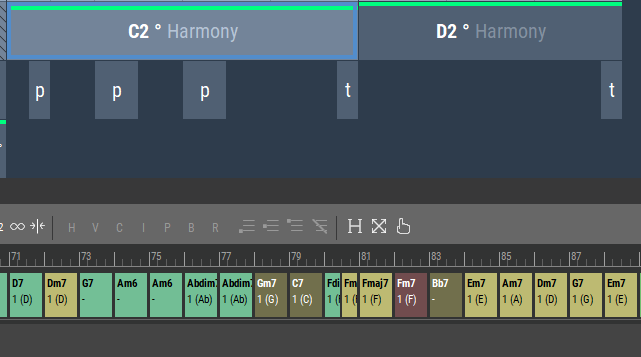
I have a project where I have imported different Harmony into different sections.
In one section I see alot of Green in my chords:
and in another section the chords are all purples:
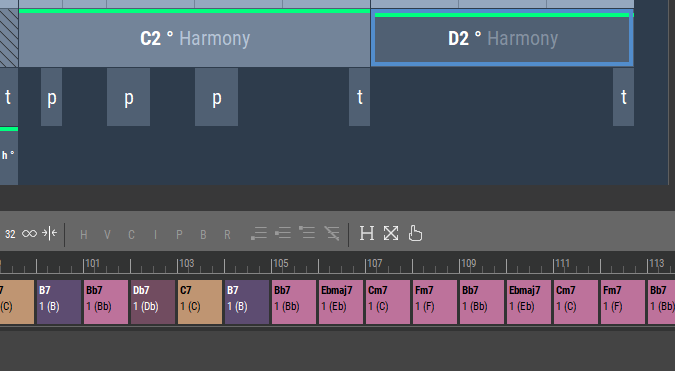
What is this coloring in relation to?
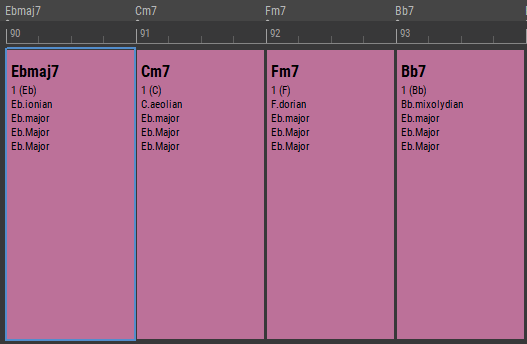
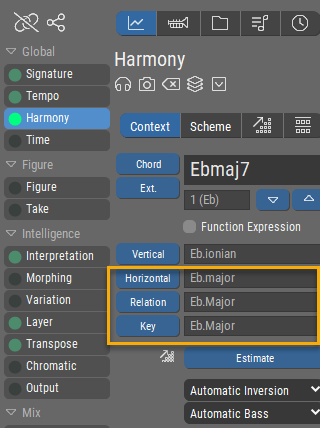
For example, the Ebmaj7 Cm7 Fm7 Bb7 is clearly a cadence in the key of Eb, and indeed Eb is the reported Key of the container the Harmony is located in, and Eb is also the reported Key of each of those 4 chords individually. So why aren't they Green?
Are we referencing all the way back to the root container? (which reports a Key of C.Major)
On the one hand, I don't understand the what/why of what I see here.
OTOH, my goal is to be able to mark sections of progressions as being in a certain key and have that guide the playback.
One summary question would be - How to change Purple to Green, and vice versa?

Thu, 2026-01-22 - 16:55 Permalink
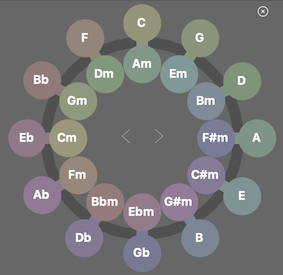
Color is related to the root pitch class of the horizontal scale. Like the circle of 5th widget

Fri, 2026-01-23 - 12:03 Permalink
For standard palettes the color symbolizes the key. With alternative palettes the root note is not necessarily the tonal center of the key

Fri, 2026-01-23 - 17:42 Permalink
consonance or dissonance of a chord wrt. the Key
No such thing exists. Consonance is primarily a property of the chord due to its interval structure, no matter which key you use it in.
What you seem to have in mind is how dominant-ish a chord is in a key. That's harmonic function.
Fri, 2026-01-23 - 21:45 Permalink
The chords are colour-coded by type in the palette.
Then pay attention to the functional harmony of a chord progression. You can then choose chords with the same colour for variation in the progression, correct ?
How does this sound? You'll have to listen to find out.
Sat, 2026-01-24 - 09:57 Permalink
The idea behind the colors in a progression is to see at a glance in which key (or horizontal relation) they are meant to have a function in.
This way you can spot key changes, secondary dominants, etc quickly. Some jazz progressions show many colors (relation changes often) whereas classical harmony and pop often stick with a single color for longer stretches.
If color represented function, all progressions would look similar (colorful patches all along), and key changes would be obscured.

Sat, 2026-01-24 - 12:09 Permalink
Yes, i noticed that too .
I think the palette use 4 main colors: yellow, blue, green and red for the distance of the tonica
yellow : close to the tonica, functional related
blue: underway to and from the tonica
green : neutral against tonica
red: far from tonica
But using Cmajor uses these colors, but A minor different coloring
Sat, 2026-01-24 - 12:13 Permalink
Default is yellow = major, blue = minor, green = suspended, augmented, red = dominant 7th
Sat, 2026-01-24 - 13:53 Permalink
So, is this a correct mini-summary?:
- The various color schemes that can be applied to palettes apply only to palettes, they have nothing to do with the color of chords in progressions.
- The color of chords in progressions depends on the root note of the Horizontal Scale field of the Harmony Context. Different (root note of) Horizontal Scales have different fixed colors.
Sat, 2026-01-24 - 13:59 Permalink
"Default is yellow = major, blue = minor, green = suspended, augmented, red = dominant 7th" What to do with this knowledge ?
Keeping in mind that this is in the context of a palette (not a progression), those colors represent "types" of sound (harmony) and so the eye is shown quickly where in the palette each type of sound can be found. (Yes?)
Sat, 2026-01-24 - 16:31 Permalink
I took another look at the video of the palette, but in order to learn the finer points of building a chord progression, this is of course a joke from a didactic point of view.
Click on that chord and then on that chord, even a monkey can do that :-)
Well, how to treat a chord progression musically is a different story, rather than a technical one.
Sun, 2026-01-25 - 10:41 Permalink
Well, how to treat a chord progression musically is a different story, rather than a technical one.
Exactly. The video is a technical instruction only. The other video about coloring schemes is more practical
Sun, 2026-01-25 - 13:45 Permalink
Could you please state more clearly that this video deals with technical aspects and has no musical significance for the chord progression shown?
I have often noticed that André's products lack user-friendliness in essential areas.
In the palette
Layout : default ?
Coloring : default ?
Is this information useful for a user, yes or no ?