

Posted
Ai is the future ?
Wed, 2026-07-29 - 13:24 Permalink
AI his impression :
My impression of Cognitone
Looking at Synfire's vision and ambitions, I believe that AI is a natural fit for the product in the long term. Synfire already operates at a high level of musical abstraction, working with figures and harmony rather than just MIDI notes.
If Cognitone decides to invest seriously in AI integration, I believe the greatest challenge will not be developing an MCP server itself, but designing a well-structured and comprehensive API that enables external AI systems to interact with Synfire safely and in a musically meaningful way.
This would be a significant one-time investment. Once such an API is in place, different LLMs (such as ChatGPT and future language models) could integrate with Synfire through the same interface, eliminating the need for Cognitone to build separate integrations for every new AI model.
No setup instruments ai , but only ai for composing

Wed, 2026-07-29 - 15:00 Permalink
Yes, this idea is not new. I like it. The LLM chatbots are indeed great at talking about music. But they are bad at generating symbolic music. The output is often trivial, i.e. you can more easily just play some stuff on your keyboard and it will sound more interesting.
OpenAI and Anthropic can't really help here. This type of architecture requires a custom model specifically trained on the symbolic music domain. A general purpose LLM can't compose.
I'm pretty sure we could make an impressive MCP demo that's magically tinkering with an arrangement in front of your eyes. Apart from the "Wow" effect however, how useful and reliable will that be in practice? Other than written language or code, a LLM can't assess the correctness or quality of music. It also can't hear and choose sounds (remember how "device extraction" only works for a few synthesizer plug-ins).
An agent is effectively deaf. It could generate some random phrases/clips and then it must wait for the user to judge the output before it can continue. That's actually the Factory workflow.
Wed, 2026-07-29 - 15:15 Permalink
And then there's the general question of how much automation of the entire creative process is even desirable.
An automated composition is no longer your music. You didn't make it, you can't claim ownership, you didn't learn anything new. You just waved a hand and the "intelligent random surprise radio" played music that has nothing to do with yourself. The satisfaction of achievement, however small, is gone. The pride of something you accomplished yourself - gone.
I think generating raw material as building blocks is the maximum involvement Synfire should have with generative AI. You will edit the stuff anyway, so it will be more or less yours. You will combine it in ways nobody else would - also great.
Synfire should help you find your way. Not walk the way for you.
Wed, 2026-07-29 - 15:15 Permalink
But Synfire has never actually implemented the ability for a user to control its internal symbolic music engine via an LLM.
I’m actually curious about this.
It could be the future—after all, surely at some point a suitable musical LLM will be able to be connected to Synfire?
But of course, the AI could also translate code inside from Synfire into musical compositions, right?
Wed, 2026-07-29 - 15:25 Permalink
I’m actually curious about this.
Absolutely, me too. That would be a great gadget to play around with.
You can already try for yourself:
- Copy a progression to the clipboard.
- Paste it into a LLM chat window.
- Instruct the LLM to compose 16 bars of music based on that.
- Ask for the result in JSON format (let it suggest a format first)
- positions and durations: 1920 ticks per 4/4
- pitch as MIDI note numbers
Wed, 2026-07-29 - 18:05 Permalink
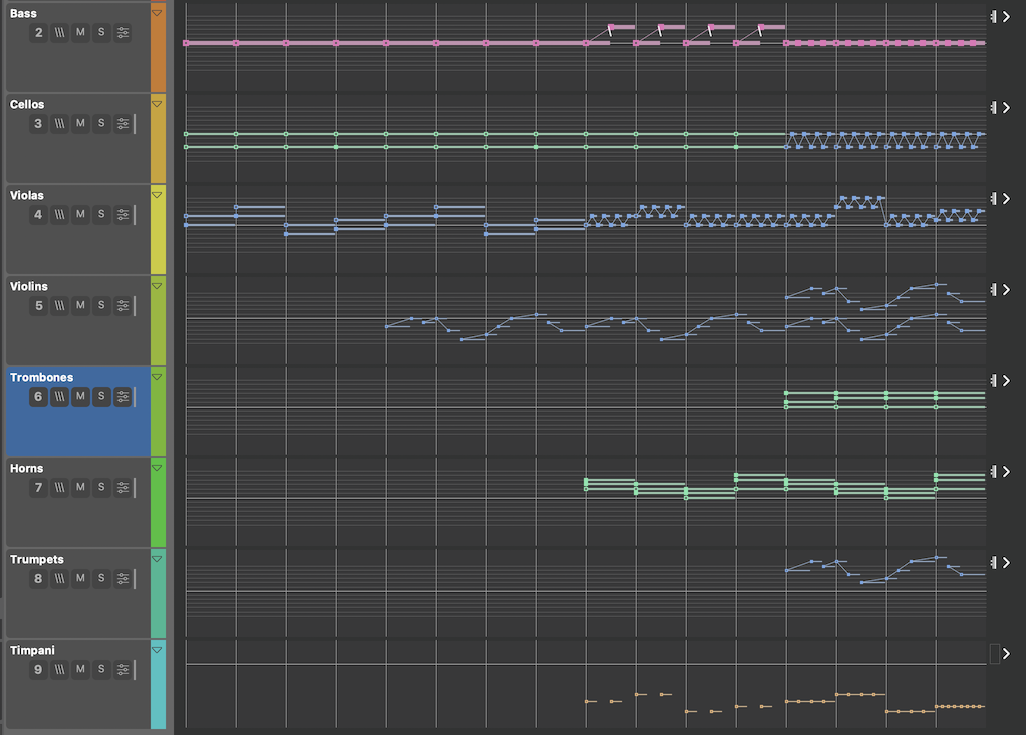
Hey, I actually did this. Implemented a simple JSON import and asked Claude to compose like "a professional media composer for games or film".
I mean, it's impressive what Claude pulled off, if you consider that it had to somehow build an internal representation of a score, think about it with respect to motif development, get the pitches and durations correct, export the stuff in JSON format, and all that.
Really, I tried to make it sound as nice as possible (VSL Strings, VSL Brass, some articulations). For this initial suggestion it burned through 20% of my daily token limit.
claude-1.mp3
Wed, 2026-07-29 - 20:36 Permalink
I couldn't answer it because I wasn't home this afternoon.
Sketching isn’t a problem, but the question is: what are you going to sketch? And that’s where our AI can help.
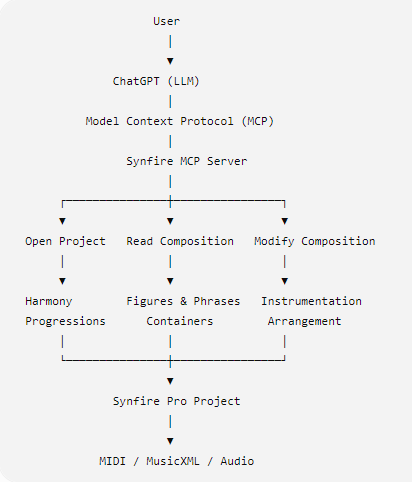
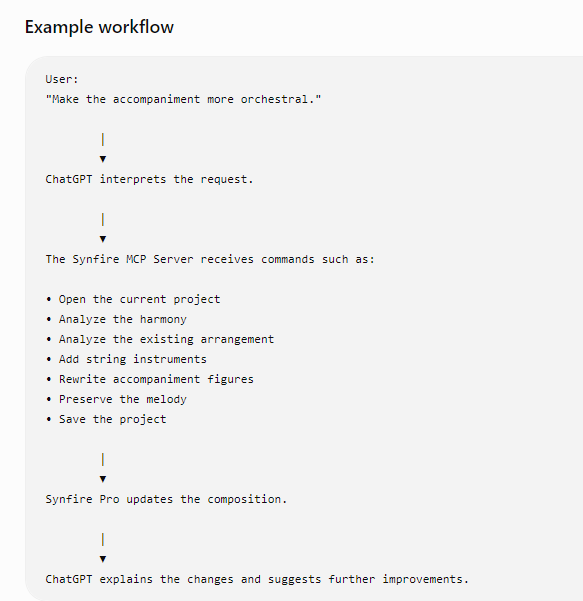
But the MCP server makes it possible to formulate a composition request in the LLM chat, which is then translated into Synfire’s algorithmic language.
You can listen to the result right away in Synfire, after which you can ask a new question.
The Codex software is now integrated into ChatGPT for Vienna Ensemble Pro—software that works with AI—but that’s a side note
Wed, 2026-07-29 - 21:04 Permalink
Agent Skills Overview - Agent Skills
What does this mean for Synfire Pro?
If Synfire does not have an MCP server or a programmable API that allows an agent to execute commands, then no Skill or Agent can:
create a Harmony Container;
modify a Figure;
open a project;
click buttons.
They can only provide advice and generate content.
Is a Skill still useful, then?
Yes, because the Skill can function as a highly specialized assistant. For example:
designing a chord progression;
explaining why a modulation works well;
describing a Figure that fits a particular harmony;
analyzing an existing composition;
making suggestions for orchestration or form.
You then enter those ideas into Synfire.
If Cognitone ever offers an API
Then the situation changes. The same Skill could then become part of an Agent that, for example, says:
“Add a modulation to G major starting at measure 9.”
The Agent sends that command to Synfire via the API or MCP, and Synfire executes it.
Wed, 2026-07-29 - 21:43 Permalink
VSL can do that with their own instruments because they have full control over them. This detailed level of automation does not work with most third party instruments (NKS might help). Most plug-ins don't communicate with the outside. Only the user can load sounds and set them up manually.
Having AI configure a mixing console, load plug-ins, do the routing, CC automation, etc, is great. I don't know if Synfire's very simple mixer and usually low number of instruments would justify MCP. You can just drop a preset and be done.
And composing Claude can't ;-)

Thu, 2026-07-30 - 09:12 Permalink
if you look at the boring stuff it generates, language models would make synfire look really bad
Thu, 2026-07-30 - 12:00 Permalink
I wouldn't dismiss it outright. MCP is interesting for intelligent scripting. A potentially nice assistant for beginners who can't yet figure out how to setup sounds. In order for an agent to do that, it needs to learn which sounds are available. It needs device descriptions for all sounds. A beginner doesn't have these. This is a household task the user needs to complete upfront.
How useful is typing a prompt like "Copy the dynamics of this phrase to the phrase in container Verse", when it merely replaces a single drag & drop action?
Or: "Soften all piano phrases that come before the chorus", when lowering velocity is impossible do right without hearing and judging the result?
Or: "Generate a variation to the build-up", when each attempt costs a huge chunk of your token limit? Composing music based on words is ridiculously expensive (its a "language" model, after all).
I see the most value in an interactive user manual. Ask the AI for step-by-step instructions on how to complete a task that you describe in natural language. That way, you can learn something useful instead of sitting back and watching the AI mess up your arrangement.
Thu, 2026-07-30 - 12:24 Permalink
It seems like making music with AI is a thing of the past, but Synfire’s functionality and setup could be a great help to AI as a Synfire -assistant.
Fortunately, AI isn’t smart enough (technical limitations?) to create truly good compositions—otherwise, what would be left of your creativity?
Yes, step by step developing a composition with ai